
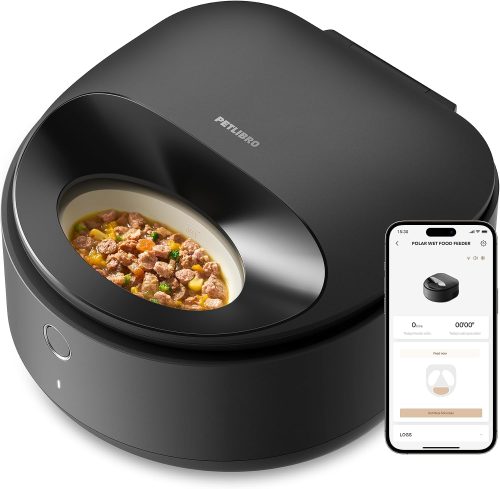
A feeder that delivers kibble at 7 a.m. solves a very different problem from one that keeps wet food cool or prevents one cat from stealing another cat’s dinner. The most useful automatic cat feeder is therefore not necessarily the one with the largest hopper or the fanciest camera. It is the one whose food format, meal schedule, access controls and cleaning requirements match the cats in your home.
For households comparing an automatic cat feeder with camera, a refrigerated wet-food feeder, or an RFID feeder for multiple cats, the critical differences are easy to miss: cameras observe feeding but do not guarantee a meal was eaten; cooling technology is not interchangeable with an ice pack; and some identification systems recognize a special collar tag rather than an implanted microchip.
How We Evaluate Automatic Cat Feeders
This is a manufacturer-documentation and published-source buying guide, not a claim of personal hands-on testing. We distinguish dry-food dispensers from chilled wet-food systems and access-controlled feeding stations. The key considerations are feeding mechanism, compatible food type, portion controls, scheduled-meal behavior during internet outages, power backup, cleaning, camera privacy and the practical limits of multi-cat feeding.
Quick Picks
PETLIBRO Polar Smart Wet Food Feeder · PETLIBRO One RFID Smart Feeder · PETLIBRO Granary Smart Camera Feeder · PETKIT YumShare Dual-Hopper 2 with Camera · Cat Mate C500 Five-Meal Feeder
Automatic Cat Feeders Compared
Buying tip: Match the feeder to the food your cat actually eats before comparing app features or hopper size.
| Feeder | Photo | Best for | Food | Key difference | Amazon |
|---|---|---|---|---|---|
| 1. PETLIBRO Polar Smart Wet Food Feeder |  |
Cooled wet meals | Wet food | Semiconductor cooling; three meals | Check price |
| 2. PETLIBRO One RFID Smart Feeder |  |
Selective access | Dry food | Collar-tag access; app controls | Check price |
| 3. PETLIBRO Granary Smart Camera Feeder |  |
Camera monitoring | Dry food | 1080p camera; two-way audio | Check price |
| 4. PETKIT YumShare Dual-Hopper 2 with Camera | 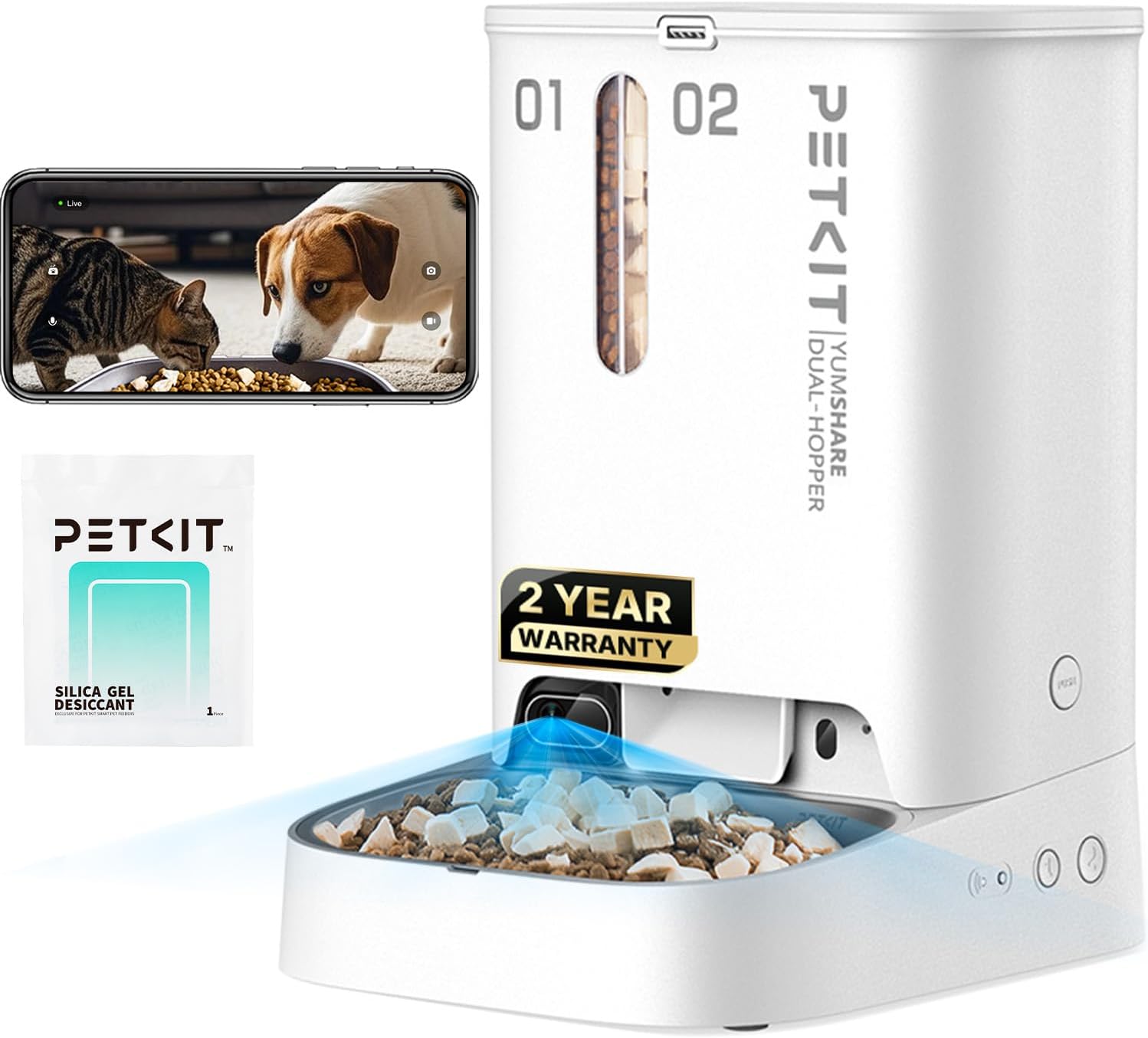 |
Two dry-food types | Dry food | Two hoppers; camera | Check price |
| 5. Cat Mate C500 Five-Meal Feeder |  |
Timed tray meals | Wet or dry food | Five compartments; ice packs | Check price |
| 6. PETLIBRO Granary Wi-Fi Smart Feeder |  |
Everyday scheduled kibble | Dry food | 5 L hopper; app feeding logs | Check price |
| 7. PETLIBRO Granary 2 Smart Feeder |  |
Updated app-controlled feeding | Dry food | Smart scheduling; updated Granary platform | Check price |
| 8. PETLIBRO Granary 2 Vision Smart Feeder |  |
Video-enabled feeding | Dry food | Camera-equipped Granary 2 variant | Check price |
| 9. PetSafe Smart Feed Second Generation |  |
App-based portion schedules | Dry food | Connected scheduled feeder | Check price |
| 10. Whisker Feeder-Robot | 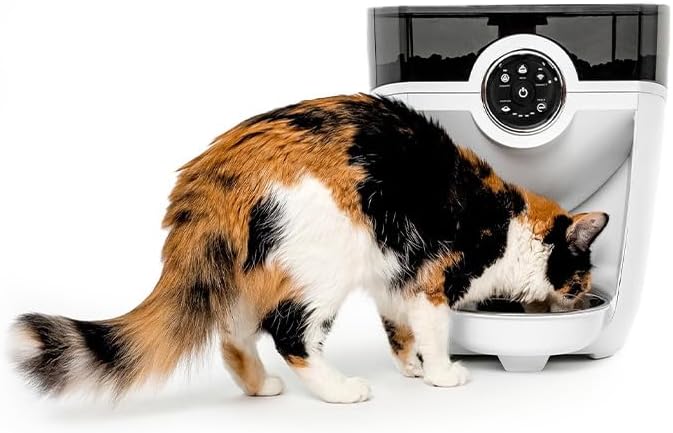 |
Large-capacity dry feeding | Dry food | Large food reservoir; app controls | Check price |
Individual Automatic Cat Feeder Reviews
1. PETLIBRO Polar Smart Wet Food Feeder — Cooled wet meals
The Polar is the strongest starting point for households that feed wet food on a regular schedule rather than using kibble as a substitute. Its three-compartment tray and active cooling differentiate it from rotating feeders that depend on frozen packs. The practical benefit is not simply convenience: the device is designed to manage food temperature between scheduled presentations. Owners should still observe the brand’s limits on storage duration, room temperature and cleaning. The machine does not eliminate the need to wash the bowl and verify that each serving is appropriate for the cat. Its main compromises are price, reliance on power for cooling, and a smaller meal count than many dry-food hoppers. It is not the right purchase for a cat that only eats kibble.
Best fit: Separate wet-food portions without ice packs. Main tradeoff: Cooling needs mains power.
2. PETLIBRO One RFID Smart Feeder — Selective access
The One is built around a different problem from a standard scheduled dispenser: keeping the wrong pet away from the food. The designated cat wears a compatible RFID collar tag that unlocks access, so the feeder can help when one pet needs a different diet. Crucially, the device is not an implanted-microchip reader. A household with several cats may need more than one feeding station and some training time. Evaluate how the lid reacts to a second pet approaching while the intended cat is eating. The benefit is individualized access, not simply an extra bowl. Owners should also check the collar fit, battery and power arrangements, and cleaning routine before relying on it for medically important feeding.
Best fit: Preventing food stealing in multi-cat homes. Main tradeoff: Requires supplied collar tag.
3. PETLIBRO Granary Smart Camera Feeder — Camera monitoring
The Granary camera version combines a scheduled dry-food hopper with a view of the feeding area. That is useful for owners who want to check whether a cat approaches the bowl, especially during a workday. Video is not the same as proof that the cat consumed a full meal, however. Confirm the camera angle from the planned installation spot, the lighting at night, and any recurring charges for recording or cloud history. Compared with a basic Granary, the camera adds an extra layer of setup and another connected component to maintain. It is a reasonable fit when monitoring matters as much as automatic dispensing, but not a compelling upgrade for a household that only needs timed kibble.
Best fit: Seeing feeding behavior remotely. Main tradeoff: Camera features add connectivity and privacy decisions.
4. PETKIT YumShare Dual-Hopper 2 with Camera — Two dry-food types
Two food compartments are the defining advantage of the YumShare Dual-Hopper 2. The arrangement is relevant when a household wants to offer two compatible dry-food recipes without manually changing the entire reservoir. The integrated camera adds visibility into the bowl area, which is helpful but does not establish how much each cat eats. Check the supported kibble sizes, the mixing and dispensing settings, and the cleaning access before choosing this over a single-hopper model. Its greater mechanical complexity may not be worthwhile for a cat that eats one consistent food. A dual hopper also should not be confused with two independently secured feeding stations for pets with different prescriptions.
Best fit: Mixing or alternating dry foods. Main tradeoff: Separate hoppers do not restrict cats individually.
5. Cat Mate C500 Five-Meal Feeder — Timed tray meals
The C500 takes a straightforward approach: instead of moving kibble through a chute, it rotates a covered tray to expose a scheduled compartment. That makes it suitable for a wider range of food textures than most tall-hopper machines. The included ice packs can help with short-term wet-food freshness, but they are not active refrigeration. Plan around room temperature and food-safety guidance rather than assuming an entire day of unattended wet meals will be appropriate. The digital timer avoids the need for an app or home internet. Its five-meal design is particularly useful for predictable portions, though owners must refill and clean the compartments and prepare the ice packs when using moist food.
Best fit: Simple scheduled tray feeding without Wi-Fi. Main tradeoff: Ice packs require preparation and have limited cooling time.
6. PETLIBRO Granary Wi-Fi Smart Feeder — Everyday scheduled kibble
For a cat eating a single dry-food recipe, the Granary Wi-Fi model offers many of the conveniences people actually use without requiring a camera. The hopper stores kibble, while the connected app supports scheduling and feeding records. That is helpful for adjusting meal timing around work shifts or dividing daily food into smaller servings. As with all auger-style dispensers, confirm that your kibble dimensions suit the mechanism and measure actual portions instead of relying only on nominal serving increments. Feeding records show what the unit dispensed, not necessarily what the cat ate. This is not a wet-food solution, and it will not stop another cat from sharing the bowl. Consider a camera version only if visual monitoring is valuable.
Best fit: Routine dry-food feeding with remote scheduling. Main tradeoff: No individual-pet access control.
7. PETLIBRO Granary 2 Smart Feeder — Updated app-controlled feeding
The Granary 2 name covers related products with different feature packages, so it is important to compare the precise version rather than assuming every listing includes a camera or a bowl scale. The standard smart feeder is aimed at routine dry-kibble dispensing with connected scheduling. That makes it more relevant to someone prioritizing reliable daily portions than to an owner shopping for wet-food cooling. Before ordering, compare the specific listing’s power backup, app requirements, food capacity and cleaning design with the original Granary. If a scale or video is the reason for upgrading, check that the selected variant explicitly includes it. A newer product name alone is not a guarantee of more useful features.
Best fit: Owners wanting a newer dry-food platform. Main tradeoff: Variant features differ across Granary 2 models.
8. PETLIBRO Granary 2 Vision Smart Feeder — Video-enabled feeding
The Vision variant is designed for owners who want the scheduled kibble features of a connected dispenser alongside a view of the feeding station. It can make checking on an absent pet more convenient, but the image should be interpreted as behavioral context rather than a precise intake measurement. In a multi-cat home, a shared camera view may still leave uncertainty about which pet ate the food. Compare the camera placement, privacy options, alert controls and any optional recording costs with the older Granary camera model. Also verify the exact listing because the Granary 2 family contains scale-equipped and non-camera products with similar names. For a single cat on dry food, this can be useful if monitoring is genuinely a priority.
Best fit: Monitoring a cat’s feeding area. Main tradeoff: Video does not guarantee food intake.
9. PetSafe Smart Feed Second Generation — App-based portion schedules
PetSafe’s second-generation Smart Feed is another approach to dispensing measured dry-food meals on a schedule. It deserves consideration from buyers who value app management and a familiar pet-equipment brand rather than camera functions. The key shopping question is whether its supported portion settings and kibble compatibility match the food you actually use. A large hopper may reduce refill frequency, but it does not eliminate cleaning or the need to check for jams. Households with more than one pet should remember that a shared bowl does not control who eats which portion. Check power and connectivity behavior against the manufacturer’s documentation, especially if meals must continue during a temporary outage.
Best fit: Breaking a daily ration into multiple dry meals. Main tradeoff: Larger footprint than simple trays.
10. Whisker Feeder-Robot — Large-capacity dry feeding
The Feeder-Robot appeals to owners who would rather refill a larger reservoir less often and manage portions through a connected interface. That makes it different from compact countertop dispensers designed around a few days of food. Its physical footprint deserves attention: measure the planned feeding location and allow enough clearance for removing and cleaning food-contact parts. A large reservoir does not mean the kibble can be left indefinitely without attention to freshness. As with any scheduled dry feeder, test several dispensing cycles with your particular kibble and weigh the result. The price premium is hardest to justify when a simple timer meets the same needs. It is not intended to keep wet food refrigerated or prevent one cat from accessing another’s bowl.
Best fit: Reducing frequent dry-food refills. Main tradeoff: Premium price and substantial footprint.
How to Choose an Automatic Cat Feeder
Automatic cat feeder for wet food: cooling versus timed lids
Most tall-hopper feeders dispense dry kibble only. A wet-food model instead uses separate covered trays, chilled compartments or a cooling mechanism. For example, PETLIBRO describes its Polar model as a semiconductor-cooled wet-food feeder, while the Cat Mate C500 uses ice packs under a rotating meal tray. Neither arrangement eliminates the need to follow the food maker’s handling guidance, wash contact surfaces and check ambient-temperature limits. If your cat eats prescription wet food, verify portion sizes and the manufacturer’s storage instructions before relying on a feeder for unattended meals.
Automatic cat feeder with camera for checking mealtimes
A built-in camera can show whether a cat approaches the bowl and can help you spot interruptions or food-stealing. Look for a view that actually includes the eating area, nighttime visibility and clearly disclosed cloud-storage costs. A camera does not weigh what an individual cat consumed unless the feeder also includes a supported scale or identification system. Check whether live video, recording and alerts require a subscription and whether footage is stored locally or remotely.
RFID cat feeder for multiple cats and different diets
In a home where one cat needs a special diet, a shared dual-bowl dispenser is not the same as selective access. PETLIBRO’s One feeder uses its supplied RFID collar tag, not an implanted microchip, to open access for the designated cat. Other systems may read compatible implanted microchips. Confirm the identification method, number of supported pets, whether every cat needs its own feeder, and whether a determined second cat can slip in while the lid is open. Introduce the device gradually so a timid cat learns to approach it.
Battery-backup automatic cat feeder for power outages
Ask two separate questions: will the motor still dispense a scheduled meal when the electricity goes out, and can you still change that schedule without Wi-Fi? Backup batteries may support feeding while video and app connectivity stop. Check the exact model’s backup-battery requirements, expected runtime, stored-schedule behavior and low-power warnings. A feeder is not a substitute for an in-person caregiver during a long trip.
Portion-control feeder for small frequent meals
Marketing claims about the number of portions can obscure the actual grams or volume released with your cat’s particular kibble. Dispensing varies with pellet size and shape. Measure several cycles into a kitchen scale and compare the result with your veterinarian’s feeding plan. For a cat on a restricted diet, the ability to calibrate and review delivered portions matters more than the maximum hopper capacity.
Frequently Asked Questions
Can an automatic cat feeder serve wet food safely?
Only use a model designed for wet food, and follow its specific cooling, timing and cleaning instructions. Dry-food hoppers are not suitable for moist food.
Will a smart cat feeder work without Wi-Fi?
Some models continue an already-programmed feeding schedule while offline, but remote changes, notifications and camera features may be unavailable. Check the exact model documentation rather than assuming offline operation.
Can an RFID feeder read my cat’s implanted microchip?
Not necessarily. PETLIBRO One uses a dedicated collar tag. Microchip-reading products have different compatibility requirements, so confirm the supported identification technology.
Do dual-bowl feeders keep cats from eating each other’s meals?
No. Two bowls can reduce crowding but do not generally restrict access to an individual pet. Choose a selective-access system when dietary separation is essential.
Does a feeder camera prove that my cat ate?
Video can show visits and behavior, but a cat approaching a bowl is not proof of how much it consumed. For intake monitoring, consider models with supported weighing or individual meal logs, and confirm their limitations.
Final Verdict
Choose by feeding problem first. For wet-food households, start by examining cooled trays and food-safety instructions. For cats that steal each other’s food, prioritize verified selective access. For owners who want reassurance during the workday, compare camera placement and recording costs. For straightforward dry-kibble schedules, a simpler battery-backed dispenser may be the more practical fit.
These are category-level recommendations; model-specific selections require confirmation of current listings and compatible variants before purchase.
Manufacturer and Editorial Sources
- PETLIBRO One RFID feeder specifications
- PETLIBRO Polar wet-food feeder
- PETLIBRO Granary camera feeder
- Business Insider automatic feeder comparisons
Disclosure: As an Amazon Associate, SizeThemUp earns from qualifying purchases.


